Dress shirt vs casual shirt: how they differ
The short answer
A dress shirt has a stiffened collar built for a tie, a smooth fine cloth such as poplin or twill, sleeves sized by length, and long tails to stay tucked. A casual shirt has a softer collar (often button-down), a textured cloth such as oxford, chambray or flannel, S-M-L sizing and a shorter hem.
Spec sheetDress shirt
- Collar
- Stiffened; spread or point; stays
- Cloth
- Poplin, twill, pinpoint
- Sleeve
- Sized by length
- Hem
- Long tails, to tuck
- Cuff
- Barrel or French
Spec sheetCasual shirt
- Collar
- Soft; button-down or camp
- Cloth
- Oxford, chambray, flannel
- Sleeve
- S, M, L sizing
- Hem
- Shorter, can be worn out
- Cuff
- Barrel, often one button
What is the difference between a dress shirt and a casual shirt?
Construction and cloth. A dress shirt is built to be worn tucked in under a jacket and tie: a firm collar, fine smooth cloth, neck-and-sleeve sizing and long tails. A casual shirt is built to be worn on its own: a softer collar, more textured cloth, simpler sizing and a shorter hem.
The line is not a single rule but a set of details that each push a shirt one way or the other. A white poplin with a spread collar is unmistakably a dress shirt; a flannel with a soft button-down is unmistakably casual; many shirts sit somewhere in between.
Dress shirt vs casual shirt: the spec sheet
| Dress shirt | Casual shirt | |
|---|---|---|
| Collar | Stiffened spread, semi-spread or point, with stays | Soft; button-down, camp, band or unlined |
| Cloth | Poplin, twill, pinpoint, end-on-end | Oxford, chambray, flannel, denim, seersucker |
| Colour | White, pale blue, quiet stripes | Any; checks, prints, washed tones |
| Sizing | Neck and sleeve in inches, e.g. 15½ 33 | S, M, L, XL |
| Length | Long, curved tails to stay tucked | Shorter, can be worn untucked |
| Cuffs | Barrel or French | Barrel, often single button; short sleeves |
| None, or one plain | Often one or two, sometimes flapped |
Which shirts sit between dress and casual?
The oxford button-down above all, plus pinpoint, royal oxford and quiet dobby shirts. They have dress-shirt construction with a little texture or a softer collar, so they work under a blazer with or without a tie. Brooks Brothers’ button-down, introduced in 1900, is the classic example.
The button-down history is Brooks Brothers’ own Brooks Brothers. Proper Cloth rates pinpoint between oxford cloth and broadcloth in formality, and oxford cloth as the least dressy of the common shirtings Proper Cloth. If your office is “business casual”, these are the shirts that do the most work.
Where do T-shirts and polos fit in the shirt family?
At the casual end, and they are made differently: T-shirts and polos are knitted, not woven, from cotton jersey and piqué. Knits stretch and drape where woven shirting holds its shape, so they are comfortable but never formal. A well-cut polo can stand in for a casual shirt in warm weather.
How jersey and piqué are built, and what to look for, is in cotton T-shirts and polos.
Which shirts should a small wardrobe start with?
A white and a pale blue dress shirt in poplin or twill for suits and occasions; a blue oxford button-down for everything smart-casual; and one or two casual shirts in chambray or flannel for the season. Add good cotton T-shirts, and you can dress for most of life.
Then get the fit right with the shirt fit guide, and choose collars with collars and cuffs.
Frequently asked questions
Usually it looks wrong, because dress shirts are cut long, with deep curved tails meant to stay tucked. Untucked, they hang well below the belt. Casual shirts are shorter with a straighter or gently curved hem, made to be worn either way. Some brands sell shorter “untucked” cuts for exactly this.
An oxford button-down sits in between. It has a collar and cuffs like a dress shirt and is often sized by neck and sleeve, but the textured oxford cloth and soft button-down collar make it smart-casual. It is fine without a tie or with a knit tie, less so with a formal suit.
A smooth, fine cloth such as poplin or twill; a stiffened spread or point collar that holds up under a tie; barrel or French cuffs; long tails; and quiet colours, white and pale blue above all. Texture, soft collars, short hems and bold patterns all move a shirt toward casual.
Sources
- 01Dress Shirt Fabrics OverviewProper Cloth reference, checked Nov 26, 2026
- 02How to Choose a Collar StyleProper Cloth reference, checked Nov 26, 2026
- 03How to Measure Your Body for Dress ShirtsProper Cloth reference, checked Nov 26, 2026
- 04Celebrating 125 Years of the Button-Down Collar ShirtBrooks Brothers, checked Nov 26, 2026
Checked November 26, 2026. Brands change their cloth, cuts and labels, so check the maker’s own page before you buy. We are independent and not paid by any company named. Read the disclaimer or how we check facts.
Related guides
- The cutT-shirts and polosKnitted, not woven: the loops behind a tee and a polo.Read the guide
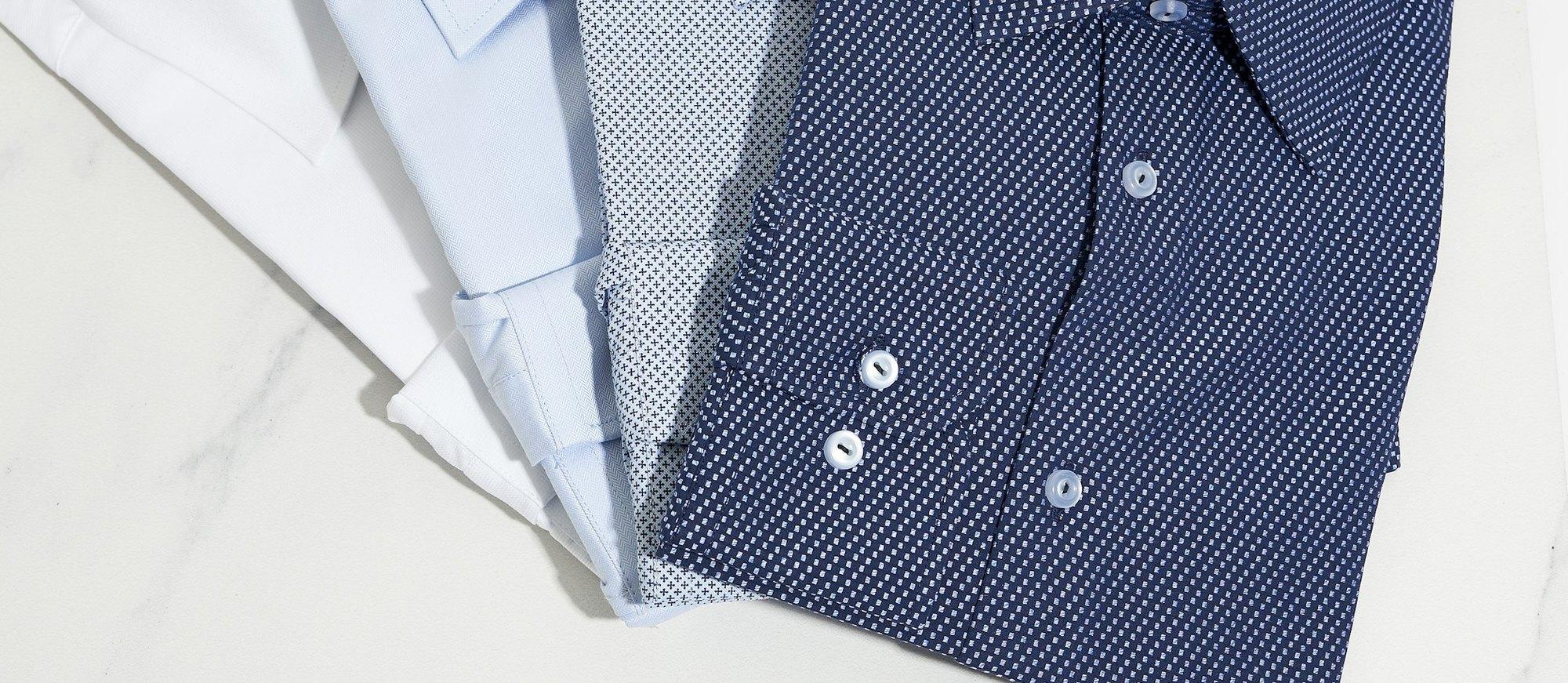 The cutCollars and cuffsSix collars and four cuffs, drawn as the pieces a shirtmaker cuts.Read the guide
 The clothShirt fabric typesTwelve cotton weaves, how each is built, and when each one earns its place.Read the guide